HotPatch
A UK-based workspace marketplace connecting beauty and creative professionals with landlords who want to maximise the utility of their spaces. As a fairly new startup, HotPatch were keen to make the journey for their customers more streamlined and to reduce potential drop-offs.
Type
Live client
Project
Group Project
Role
PM & UX Lead
Rethinking workspace search & discovery
Overview
Challenge
The brief had three tasks; fixing filtering issues, a premium-experience audit, and improving the returning-user flow. Three tasks in 2.5 weeks meant we had to scope ruthlessly, I made the call to descope the premium audit and focus where we'd have the most impact by prioritising the bookers' flow while keeping hosts in mind.
Solution
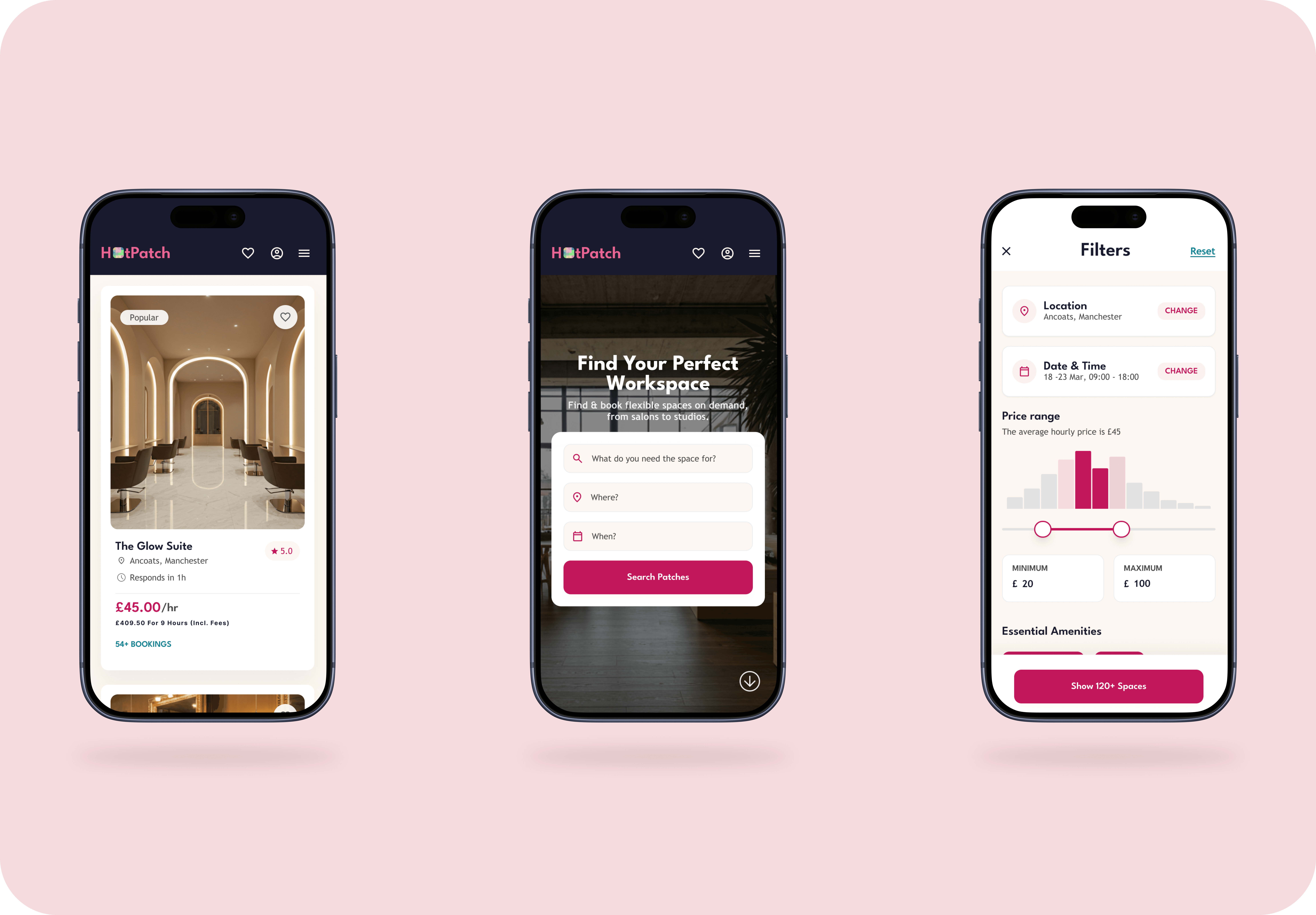
We delivered a hi-fi prototype with three key changes: smarter search and better filtering to improve discovery; easier space evaluation and comparison with richer information and a wishlist feature; and an accessibility-led visual refresh.
My Role
A team of 4 designers - Project Manager and UX Lead (me), Research & Synthesis Lead, Ideation Lead, and a Prototype Lead. I owned client communications, project planning, the final client presentation, overall strategy, finalising the prototype and leading on usability testing.
01 Discover
Understand and uncover
Three methods, triangulated into one picture.
We ran interviews and usability testing with 6 participants (a mixture of hosts and bookers provided by the client) to understand current habits and friction, a competitor analysis with 4 competitors (PeerSpace, UK Therapy Rooms, Airbnb and Treatwell) to benchmark against industry standards and spot opportunities, and a heuristic evaluation on the live site using Nielsen’s 10 to test usability and cognitive load. The SUS survey gave us a quantitative baseline to measure against later.
01
Bookers frustrated with search results. Host listings buried.
Bookers struggled to find what they needed because of poor search functionality as HotPatch had a category system instead of a keyword search option like most competitors. Users also found the filters excessive and relevant listings were being pushed down while newly added ones floated to the top.

02
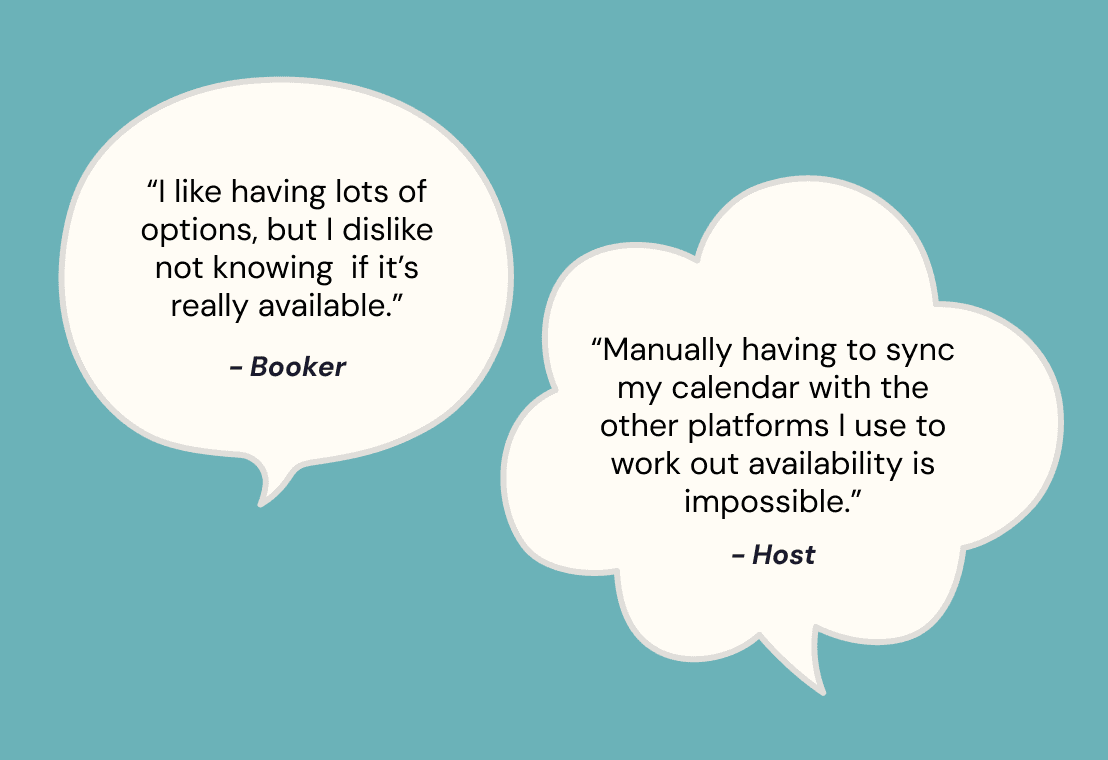
Hosts frustrated with availability input. Bookers don’t trust availability.
Hosts dreaded updating availability as the tedious task to manually update took up time, especially when listing on multiple sites. While not updating caused forced back-and-forth messaging with bookers and eroded trust in the booking process.
03
Inconsistent information makes comparison tricky.
It was clear that there was a lack of consistent pricing during the heuristic evaluation. Competitors had standardised card information and a way to shortlist options, neither features HotPatch had which meant every search started from scratch and results weren’t easy to compare, pushing users toward rivals.

Carrying research forward to define.
We carried our key findings forward to define our personas, core problem and ‘how we might we’ statements.
01 Discover
Understand and uncover
Three methods, triangulated into one picture.
We ran interviews and usability testing with 6 participants (a mixture of hosts and bookers provided by the client) to understand current habits and friction, a competitor analysis with 4 competitors (PeerSpace, UK Therapy Rooms, Airbnb and Treatwell) to benchmark against industry standards and spot opportunities, and a heuristic evaluation on the live site using Nielsen’s 10 to test usability and cognitive load. The SUS survey gave us a quantitative baseline to measure against later.
01
Bookers frustrated with search results. Host listings buried.
Bookers struggled to find what they needed because of poor search functionality as HotPatch had a category system instead of a keyword search option like most competitors. Users also found the filters excessive and relevant listings were being pushed down while newly added ones floated to the top.
02
Hosts frustrated with availability input. Bookers don’t trust availability.
Hosts dreaded updating availability as the tedious task to manually update took up time, especially when listing on multiple sites. While not updating caused forced back-and-forth messaging with bookers and eroded trust in the booking process.
03
Inconsistent information makes comparison tricky.
It was clear that there was a lack of consistent pricing during the heuristic evaluation. Competitors had standardised card information and a way to shortlist options, neither features HotPatch had which meant every search started from scratch and results weren’t easy to compare, pushing users toward rivals.
Carrying research forward to define.
We carried our key findings forward to define our personas, core problem and ‘how we might we’ statements.
02 Define
Focus and frame
Meet Sarah and Penelope.
After affinity mapping and drawing out key insights, we used AI as a synthesis tool to create two personas for both bookers and hosts. We refined them until they accurately reflected what the research told us.
Host
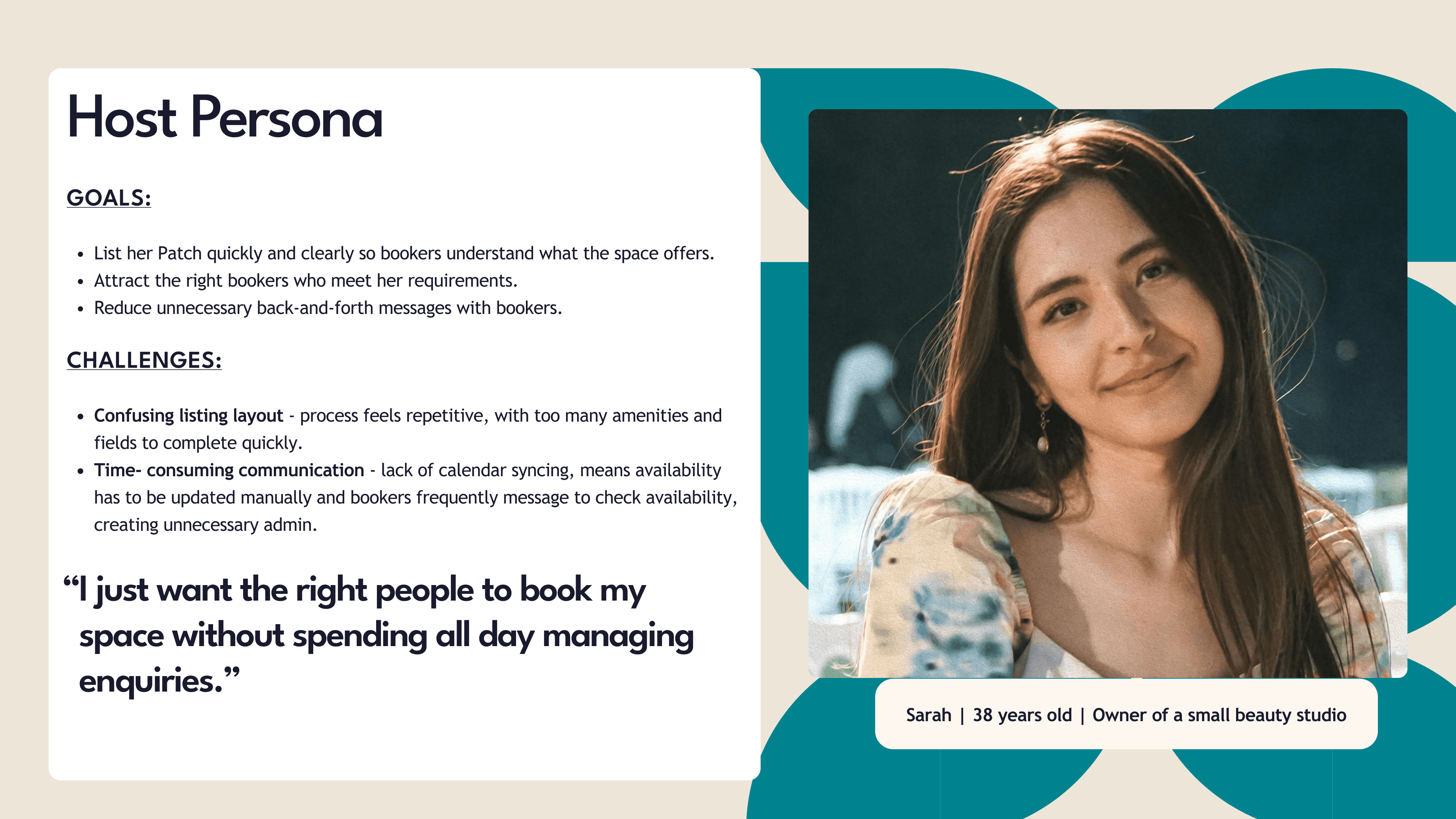
Sarah owns a small beauty studio and rents rooms to other therapists via HotPatch and UK Therapy Rooms. She’s busy and wants less time managing listings or messaging renters. HotPatch feels time-consuming as she can’t sync her availability, and the amenity list feels repetitive.
Booker
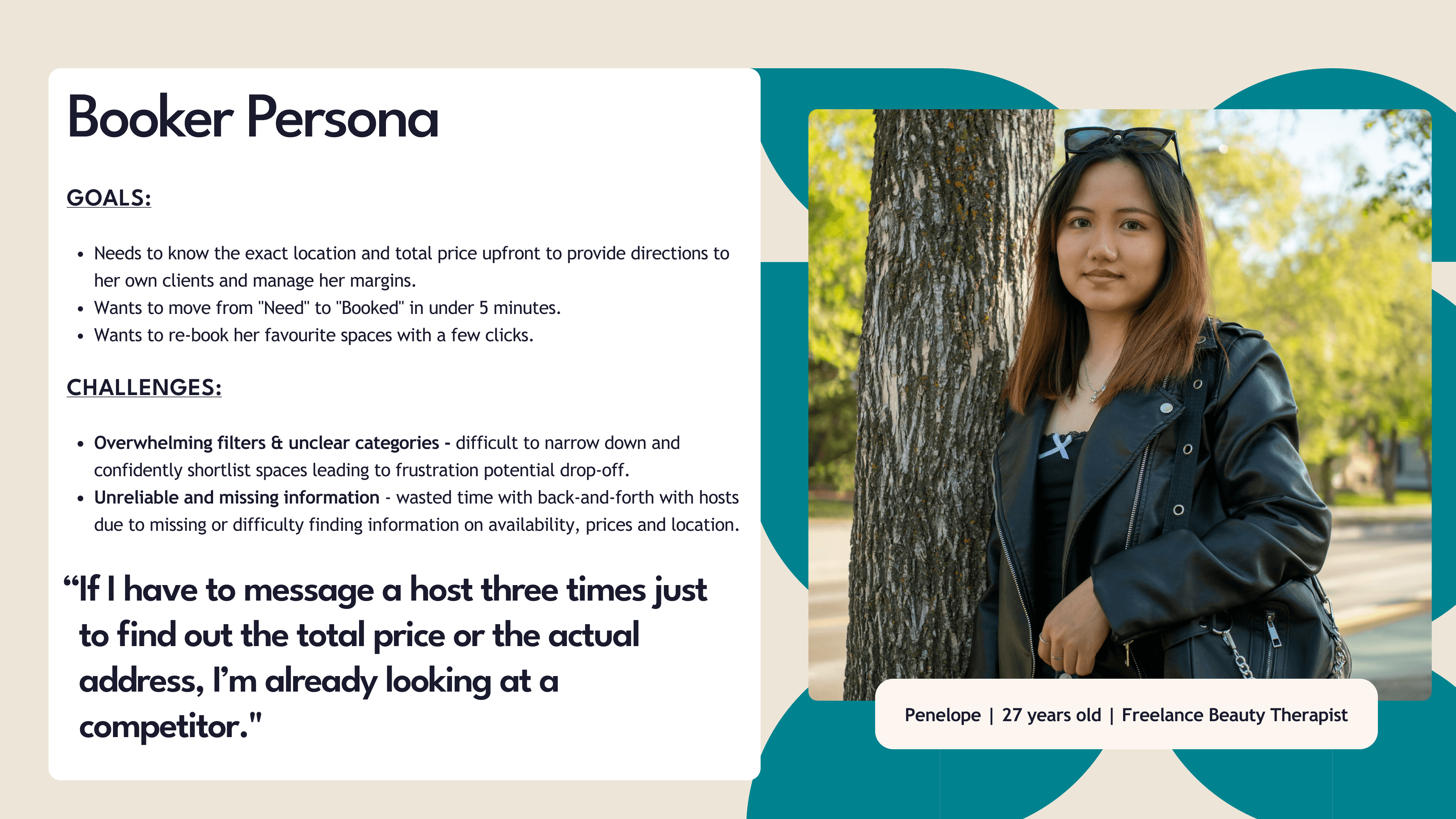
Penelope is a freelance beauty therapist looking for spaces to meet clients. She needs exact location and total cost upfront, and wants to go from “I need a patch” to “I’ve got a patch” in under 5 minutes. She stays when she can rebook favourites or compare easily. She leaves when she has to message back and forth or start from scratch.
Success meant less friction and higher SUS scores.
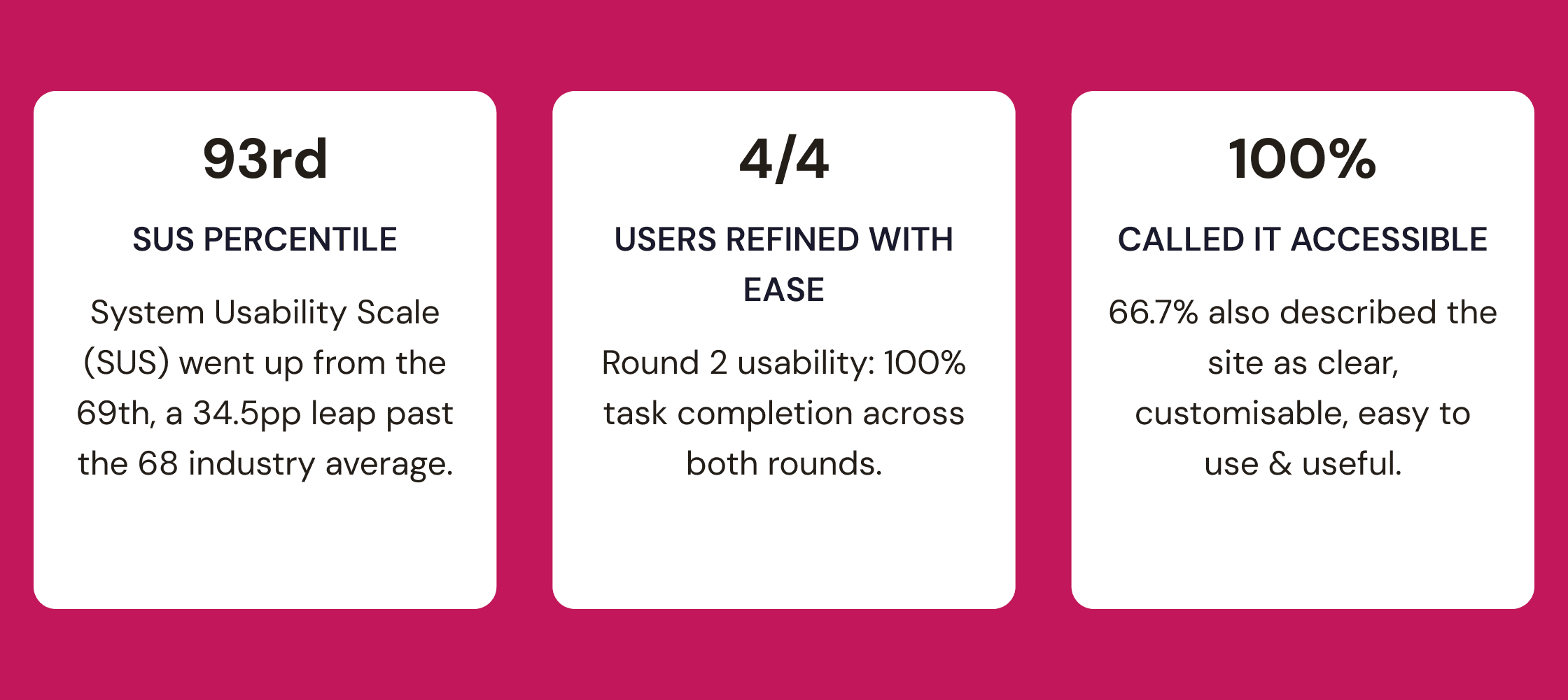
For bookers success would mean less friction when finding, filtering and evaluating patches which in turn would increase conversions. For hosts, it meant their listings weren’t buried. For the site, success would be moving the score above the current 69th percentile, which was barely above the 68 industry average.
The trade-off for one user, one problem and one question for ideation.
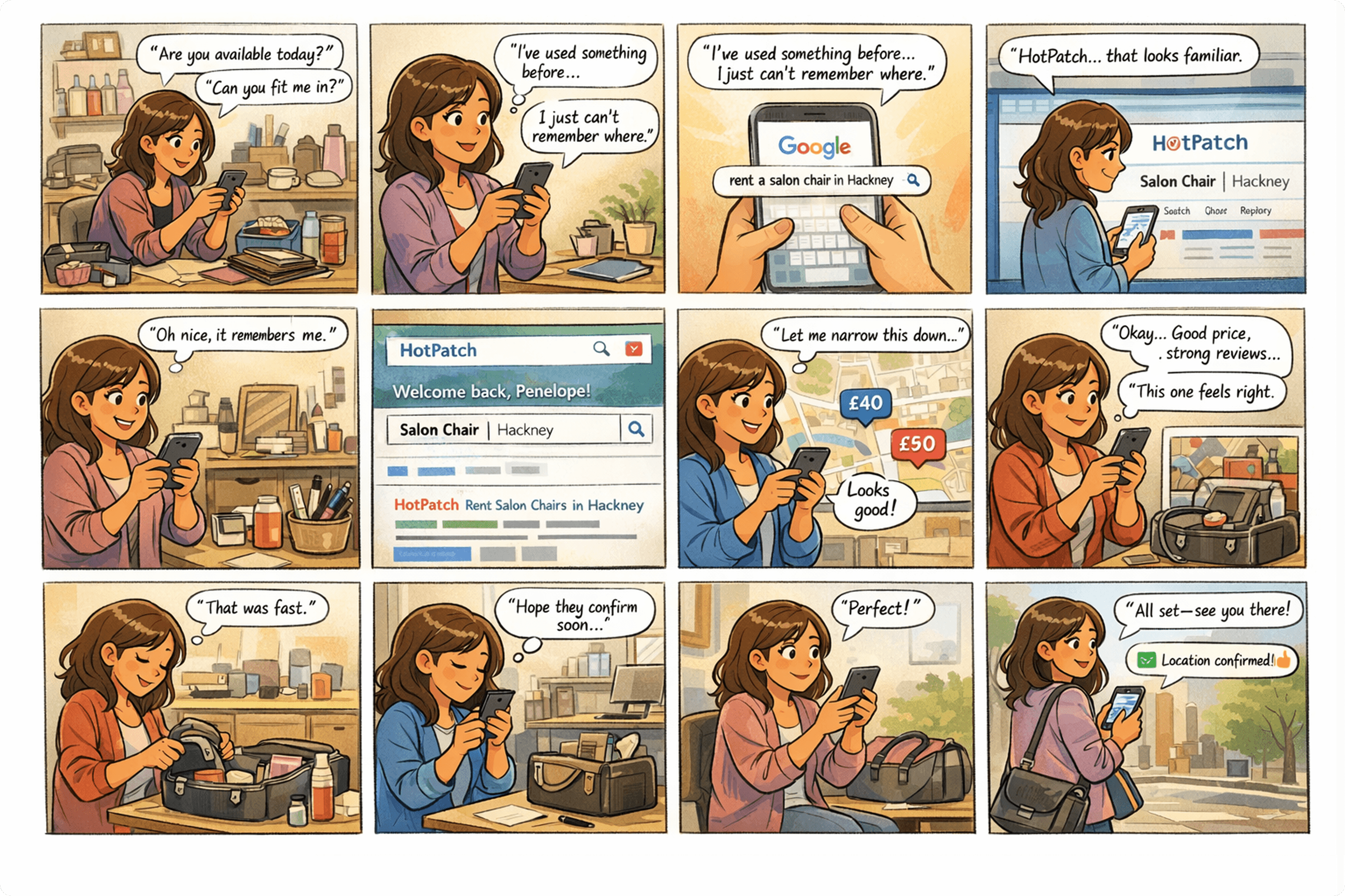
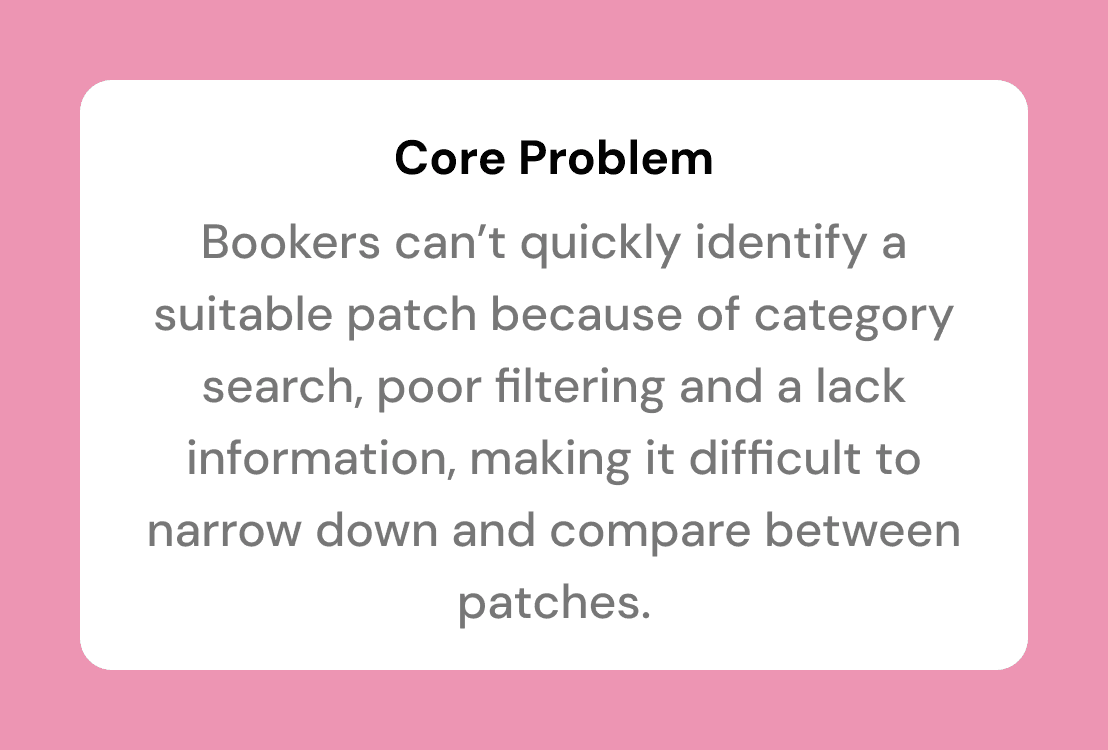
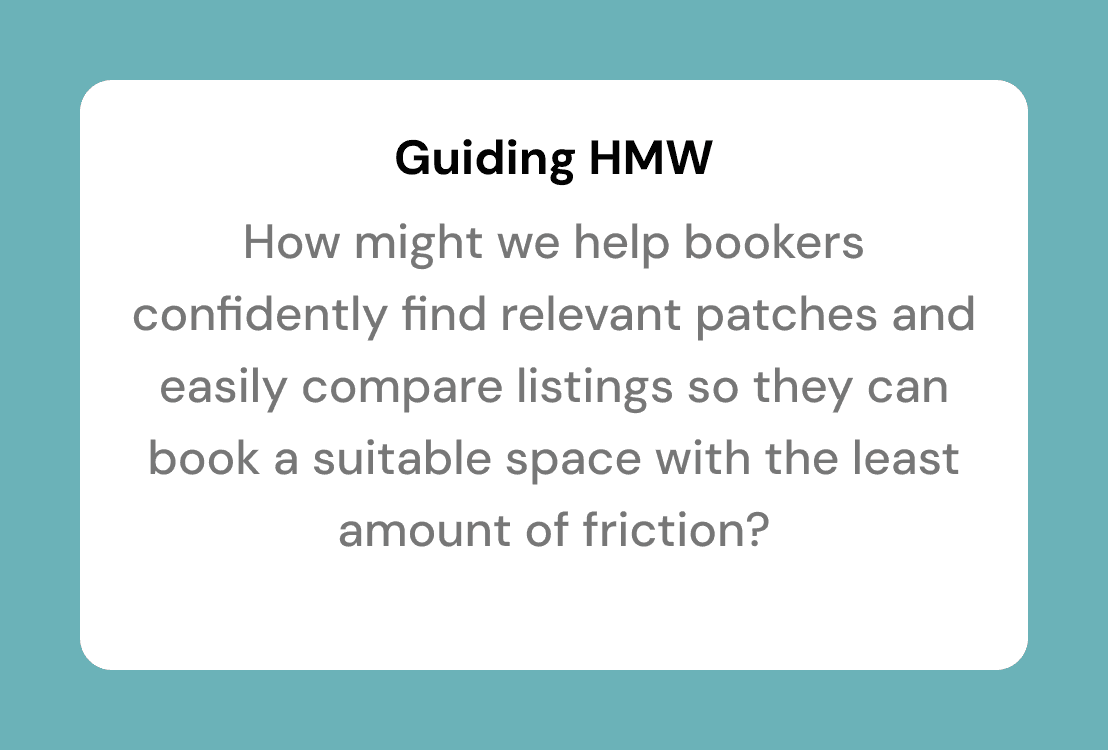
In the ideation workshop, we walked the client through both user journeys, and I explained why prioritising bookers would create the biggest impact. From there, we agreed on a core problem and landed on one guiding HMW, out of the 8 we’d drafted, to take into ideation.
02 Define
Focus and frame
Meet Sarah and Penelope.
After affinity mapping and drawing out key insights, we used AI as a synthesis tool to create two personas for both bookers and hosts. We refined them until they accurately reflected what the research told us.
Host
Sarah owns a small beauty studio and rents rooms to other therapists via HotPatch and UK Therapy Rooms. She’s busy and wants less time managing listings or messaging renters. HotPatch feels time-consuming as she can’t sync her availability, and the amenity list feels repetitive.
Booker
Penelope is a freelance beauty therapist looking for spaces to meet clients. She needs exact location and total cost upfront, and wants to go from “I need a patch” to “I’ve got a patch” in under 5 minutes. She stays when she can rebook favourites or compare easily. She leaves when she has to message back and forth or start from scratch.
Success meant less friction and higher SUS scores.
For bookers success would mean less friction when finding, filtering and evaluating patches which in turn would increase conversions. For hosts, it meant their listings weren’t buried. For the site, success would be moving the score above the current 69th percentile, which was barely above the 68 industry average.
The trade-off for one user, one problem and one question for ideation.
In the ideation workshop, we walked the client through both user journeys, and I explained why prioritising bookers would create the biggest impact. From there, we agreed on a core problem and landed on one guiding HMW, out of the 8 we’d drafted, to take into ideation.
03 Develop
Ideate and iterate
Prioritised features from our Crazy 8’s.
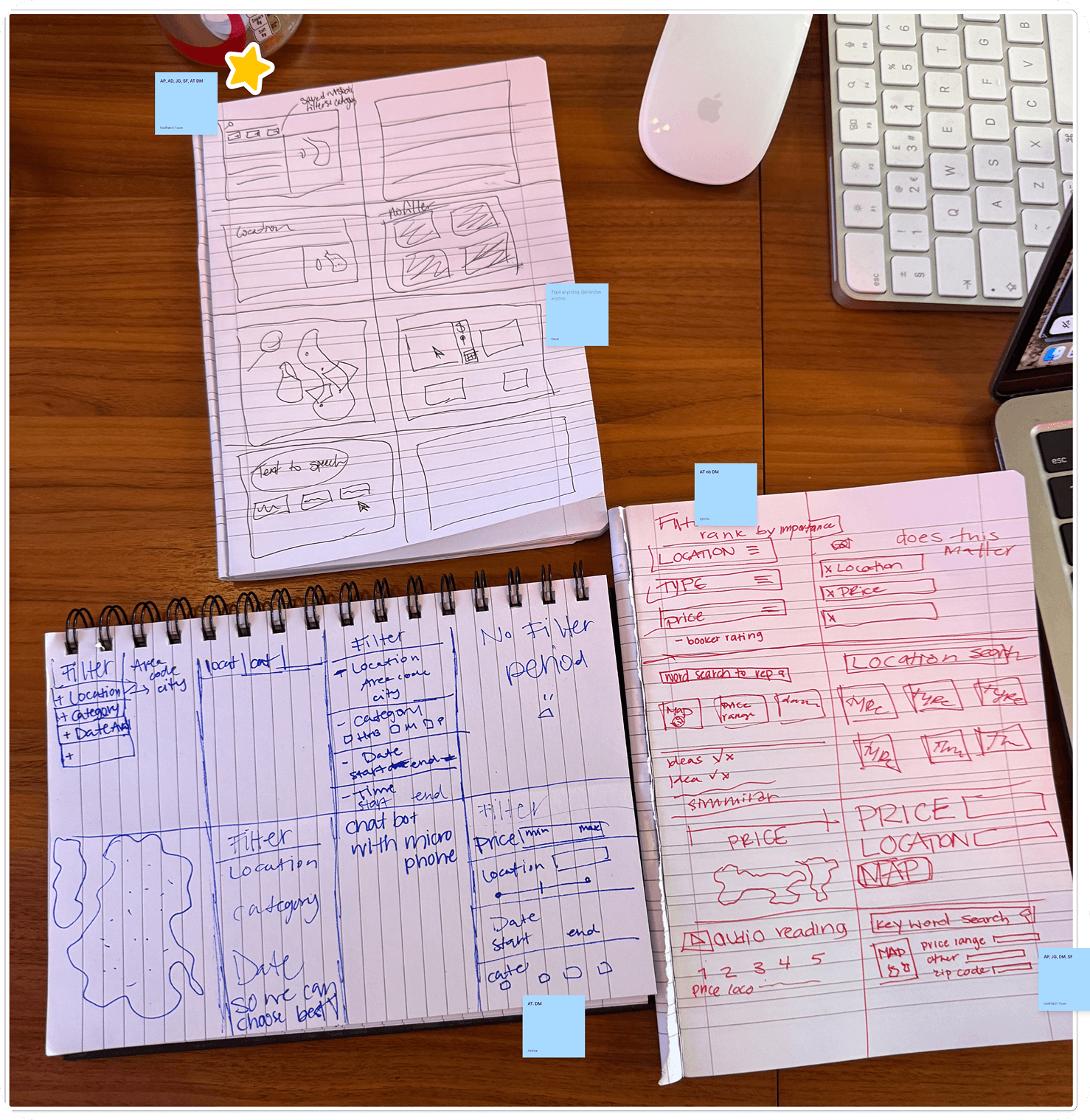
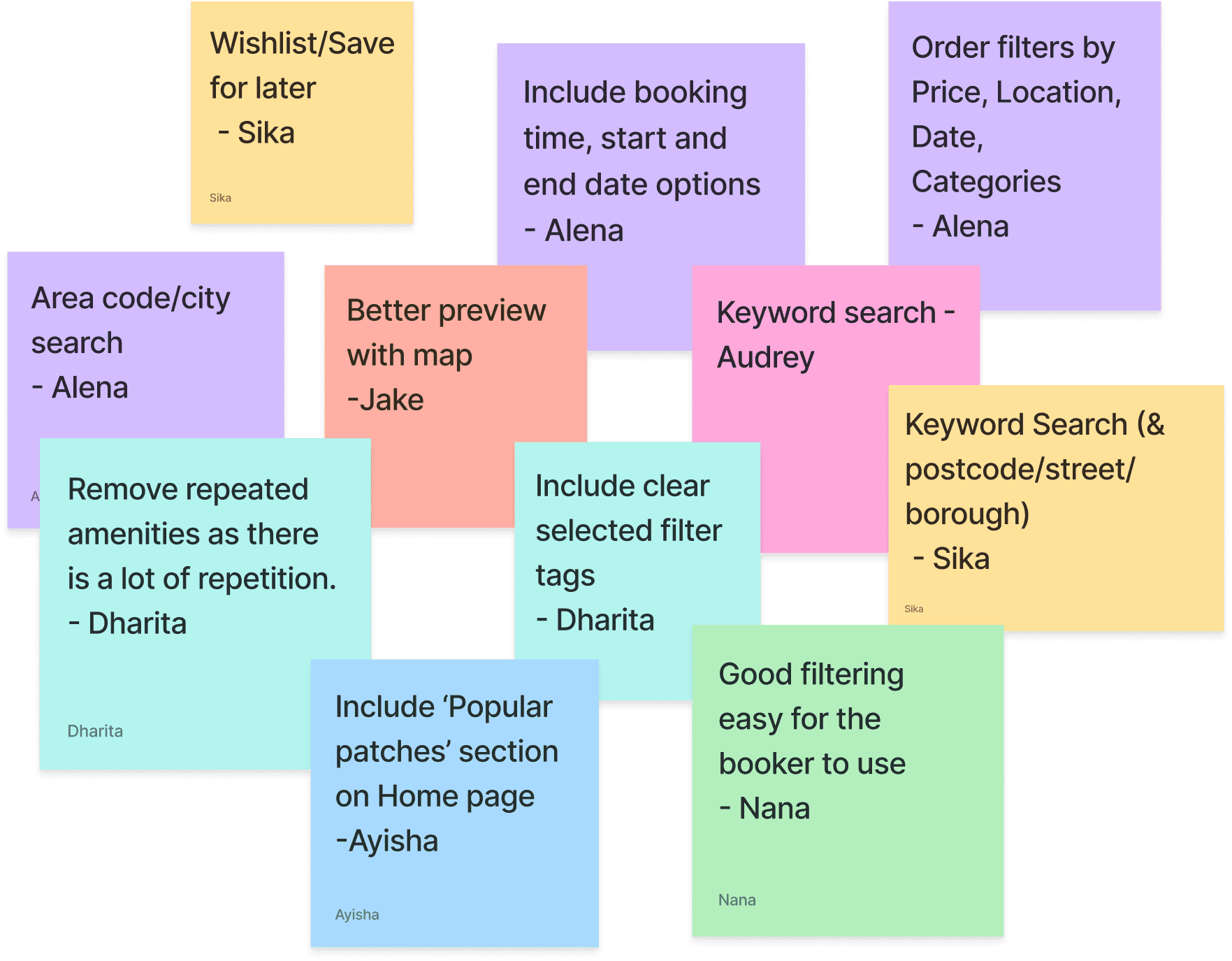
With the problem framed the team and client sketched against the one guiding HMW statement. We voted on the strongest ideas, then mapped impact vs effort on a prioritisation matrix to decide what to build and what to park.
User flow to sketching wireframes.
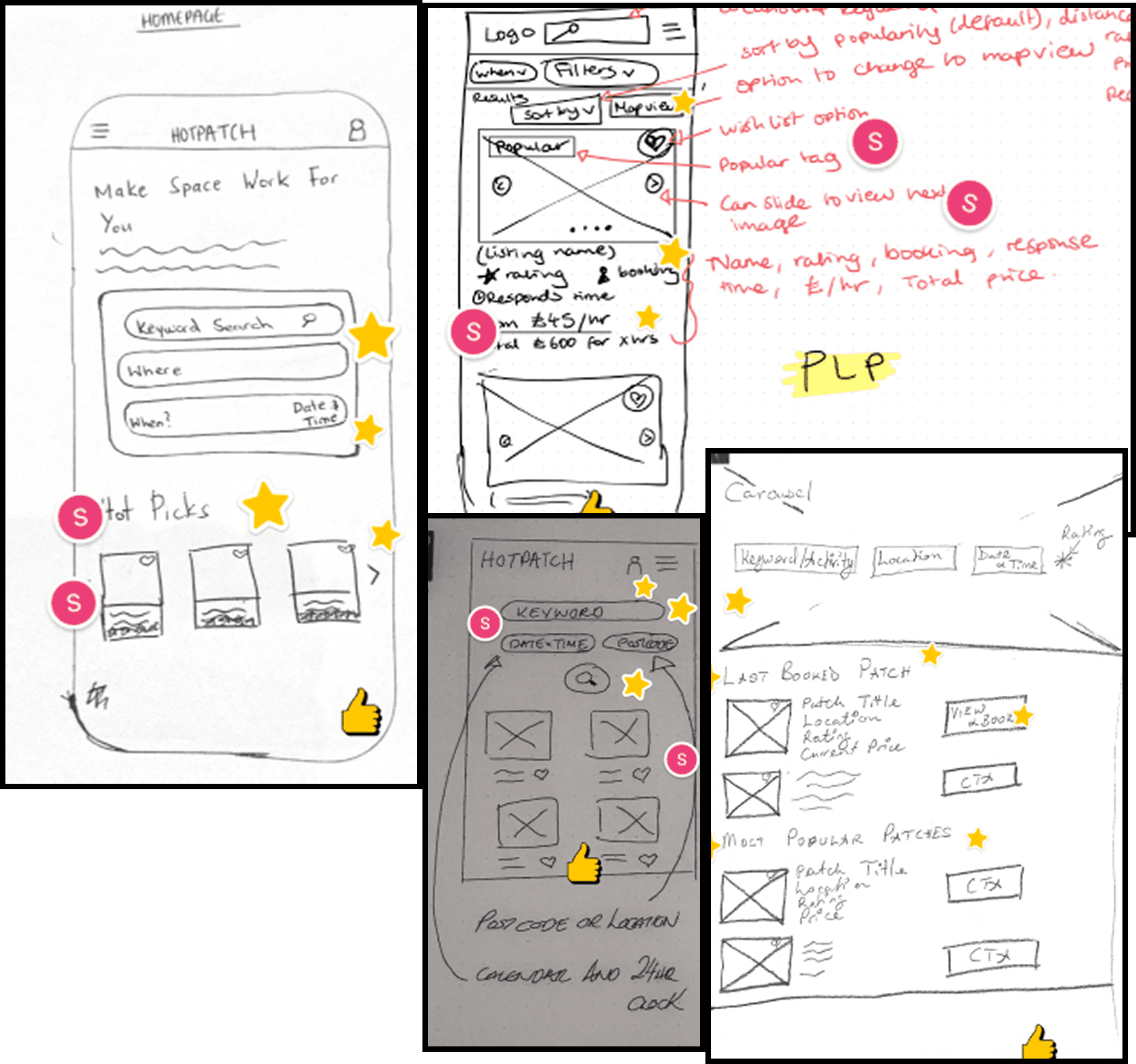
With the client we built a short storyboard and mapped it into a user flow. We each sketched the Home, PLP, Filters and PDP with our chosen features in mind. We picked the strongest elements, and the Prototype lead and I took them into a mid-fi prototype using AI and Figma.
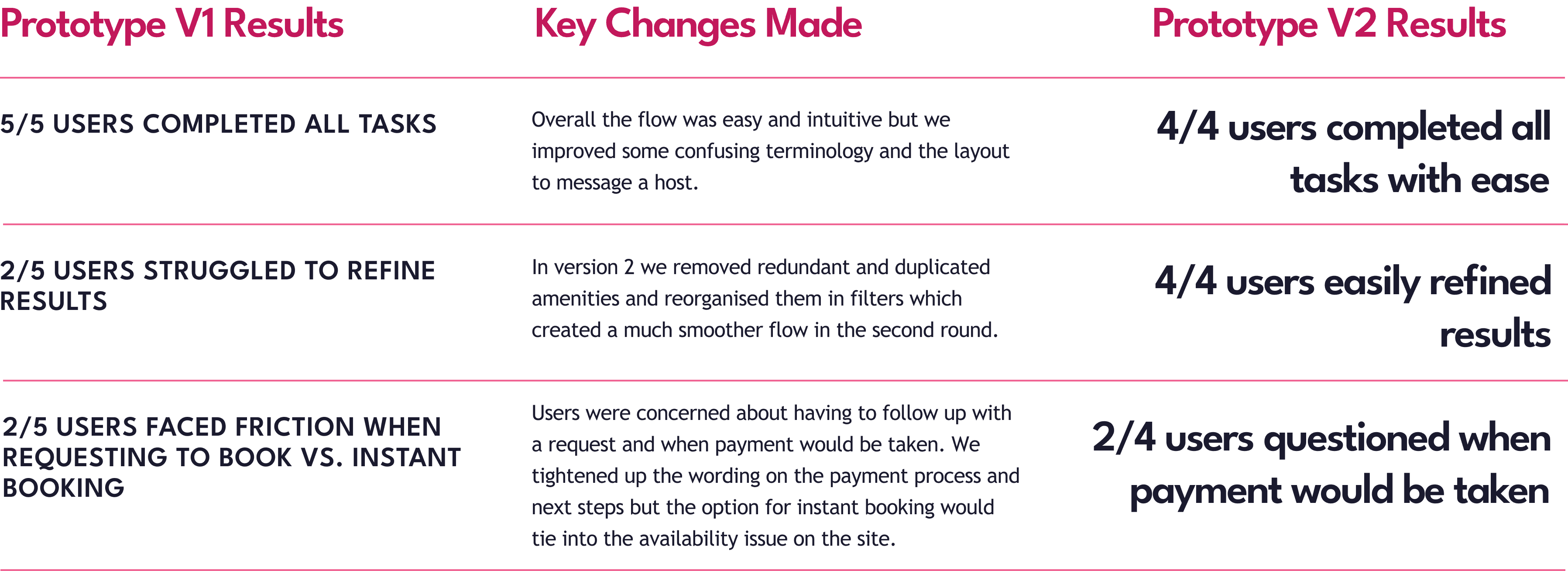
Minimal to no friction during usability testing.
After I finalised the plan for our usability test and SUS survey, we conducted a total of 9 sessions on our prototype version 1 and 2. Our goal was to see how new and existing bookers would navigate the redesigned search and discovery flow, if users could efficiently narrow down their results, easily compare between spaces and confidently evaluate a space with minimum questions in mind before they decide to book.
01
Improved search
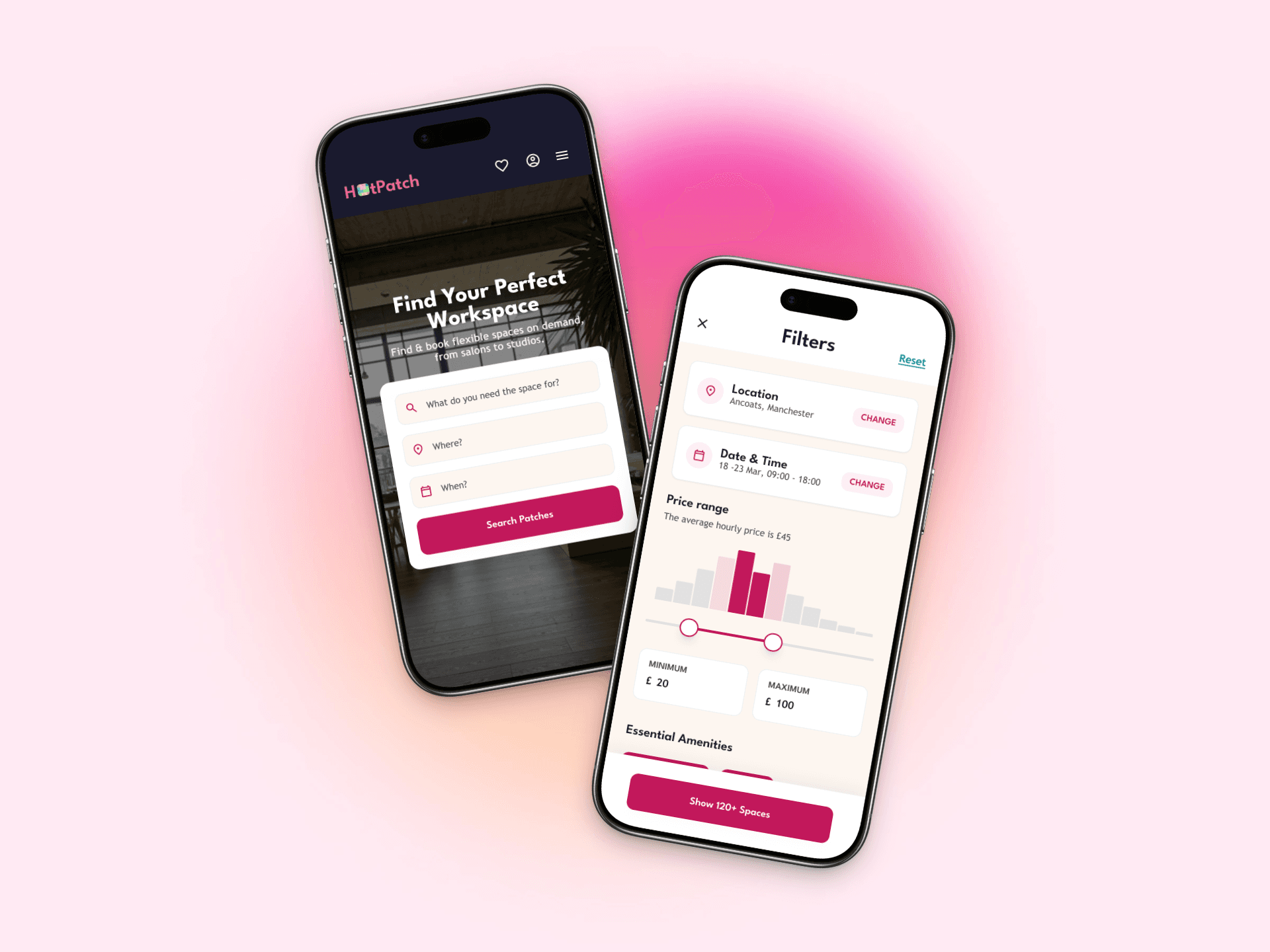
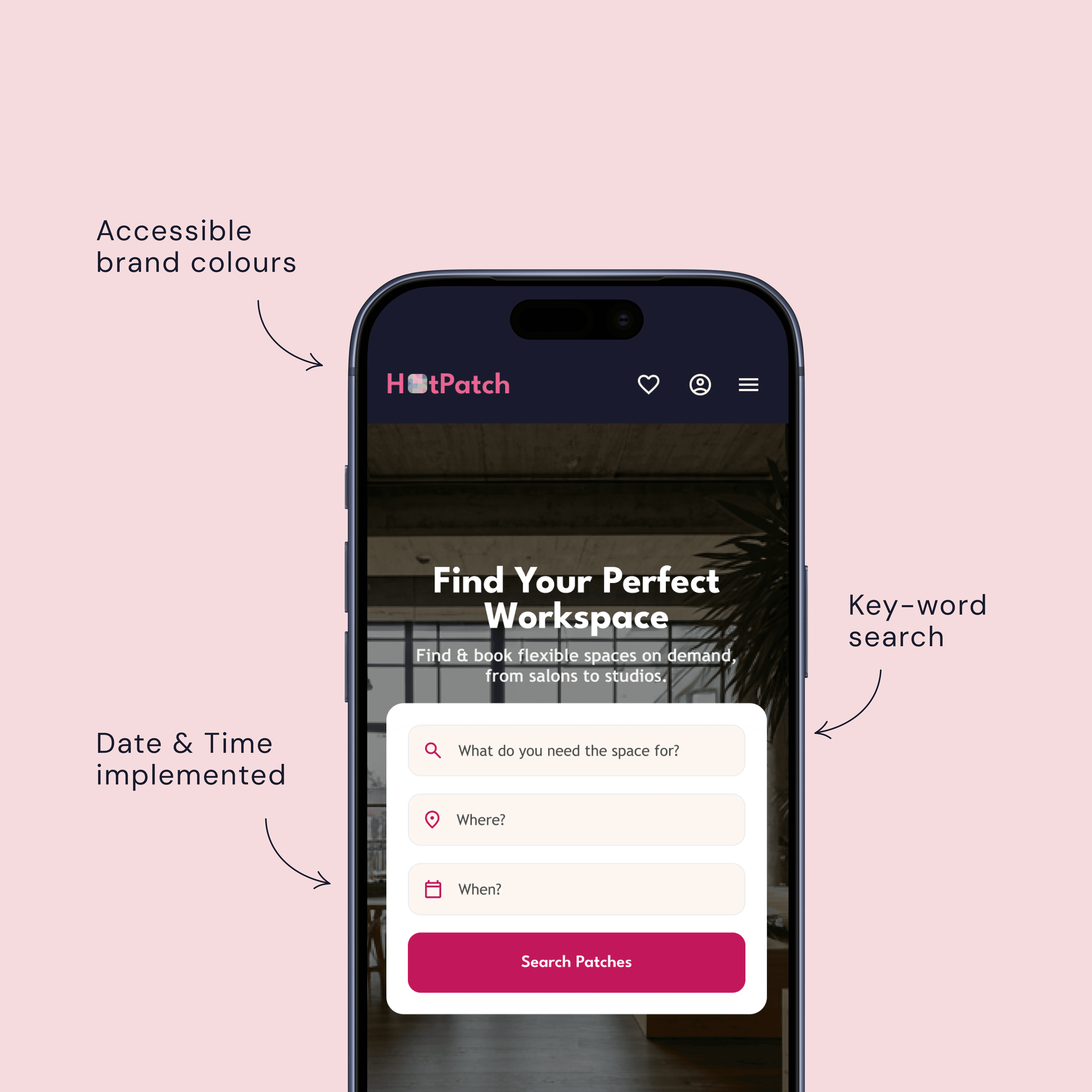
Replaced category search with adding a keyword search and a date and time option so users see relevant spaces with the dates they have in mind early in their journey.
02
Simplified filters
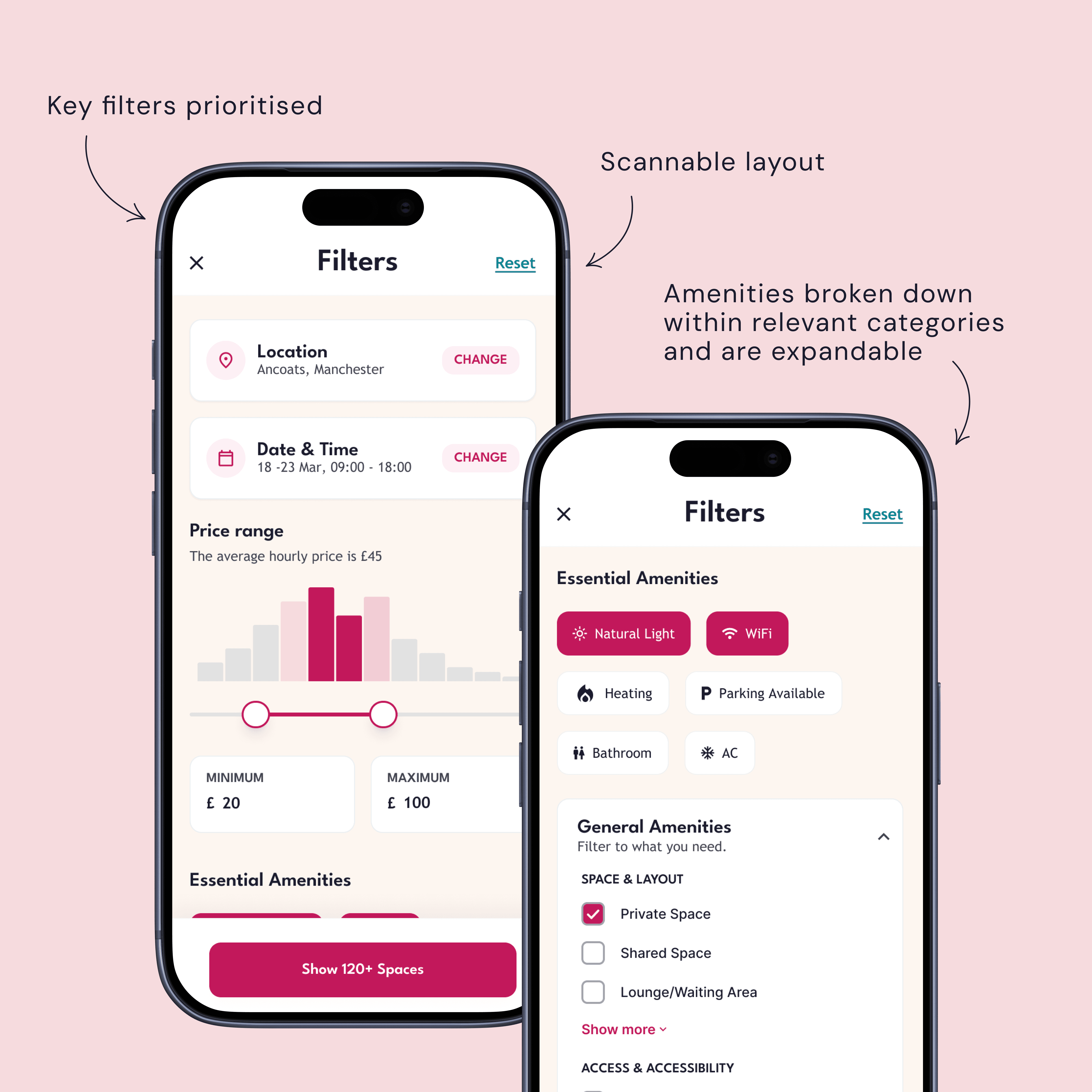
Reordered filters to what matters to users so that location, date/time and price moved to the top. Redundant amenities removed and essential ones kept.
03
Easy listing comparison
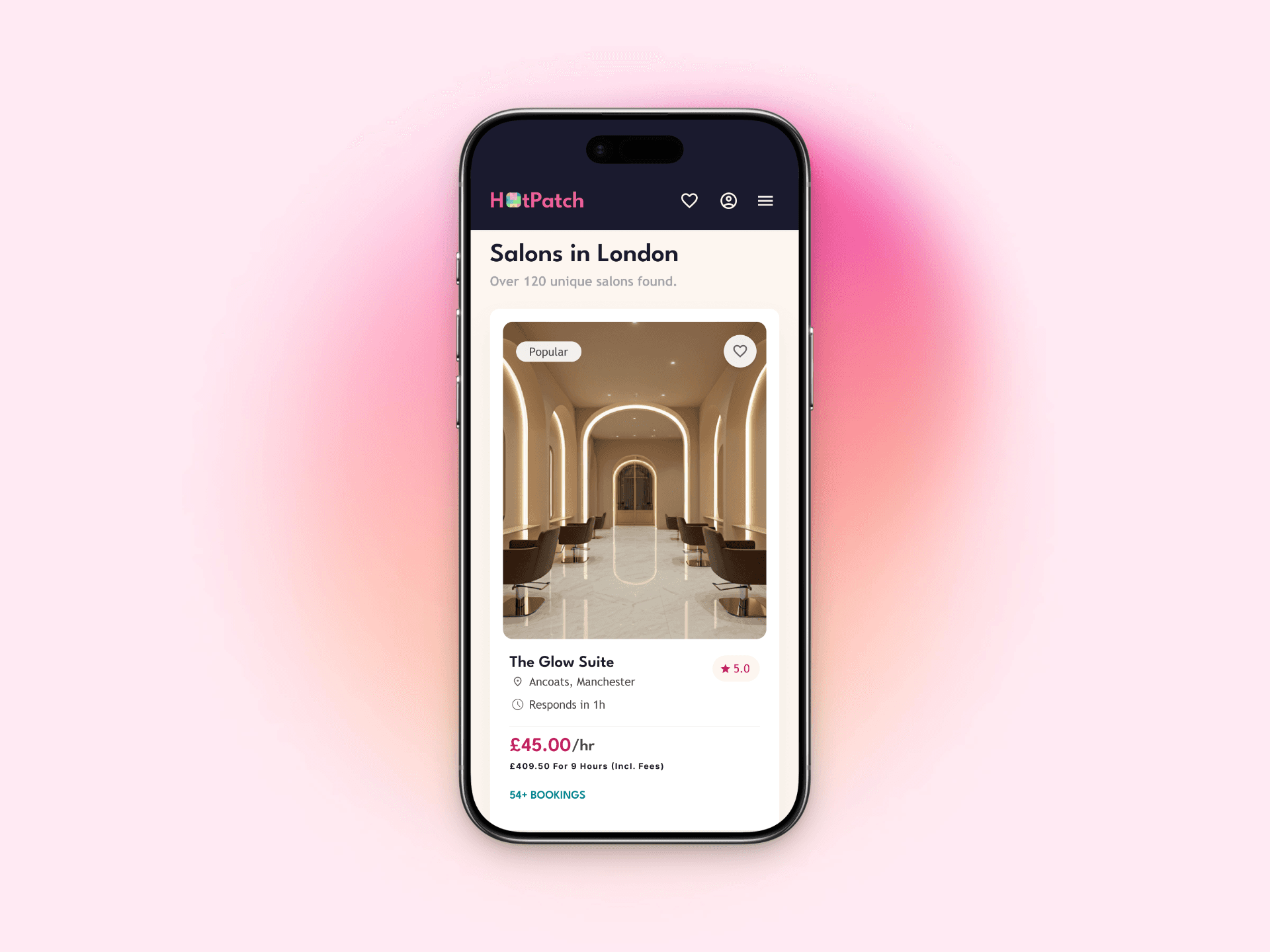
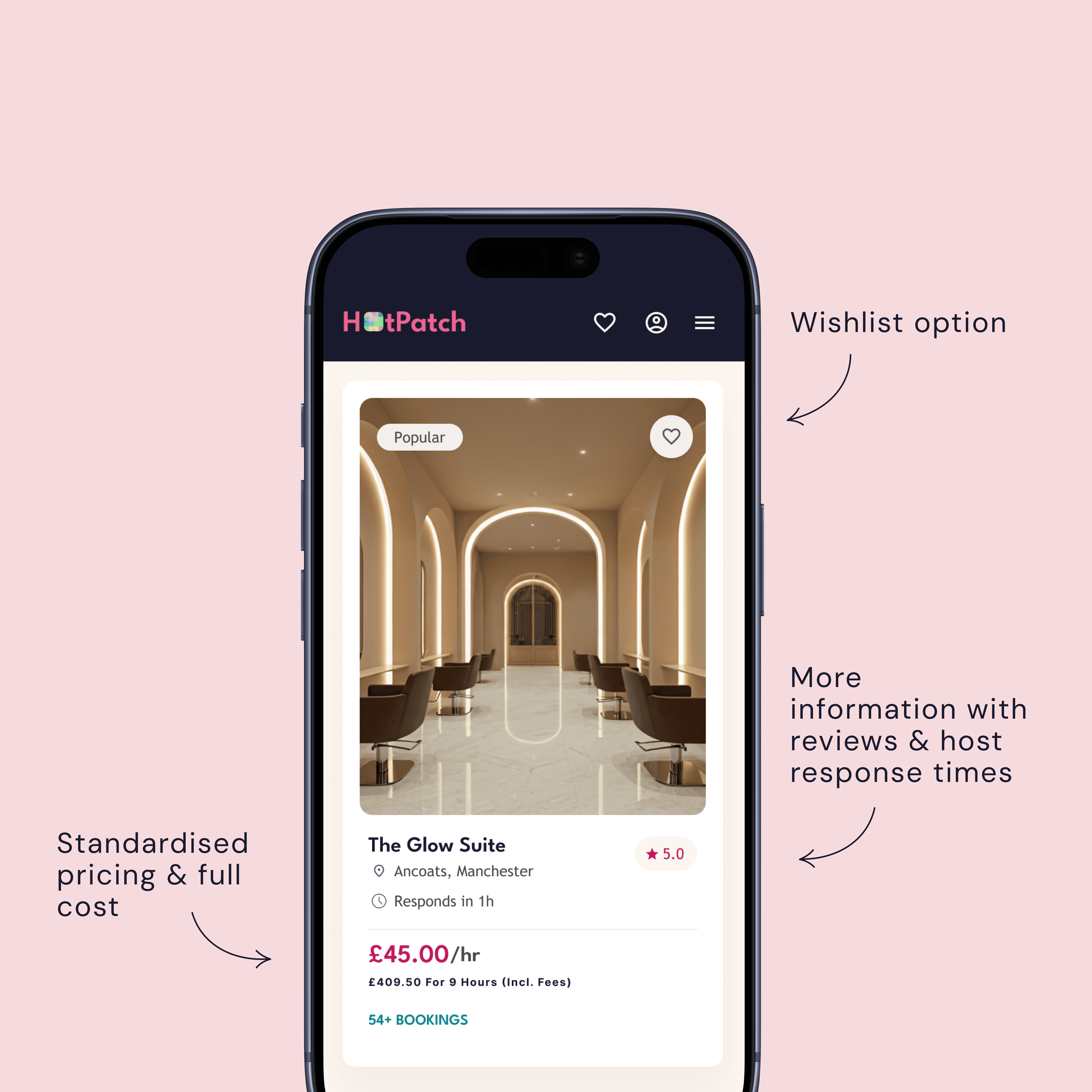
We made listing card information richer by standardised pricing by the hour, adding ratings & booking counts and a wishlist option to shortlist without juggling tabs.
03 Develop
Ideate and iterate
Prioritised features from our Crazy 8’s.
With the problem framed the team and client sketched against the one guiding HMW statement. We voted on the strongest ideas, then mapped impact vs effort on a prioritisation matrix to decide what to build and what to park.
User flow to sketching wireframes.
With the client we built a short storyboard and mapped it into a user flow. We each sketched the Home, PLP, Filters and PDP with our chosen features in mind. We picked the strongest elements, and the Prototype lead and I took them into a mid-fi prototype using AI and Figma.
Minimal to no friction during usability testing.
After I finalised the plan for our usability test and SUS survey, we conducted a total of 9 sessions on our prototype version 1 and 2. Our goal was to see how new and existing bookers would navigate the redesigned search and discovery flow, if users could efficiently narrow down their results, easily compare between spaces and confidently evaluate a space with minimum questions in mind before they decide to book.
01
Improved search
Replaced category search with adding a keyword search and a date and time option so users see relevant spaces with the dates they have in mind early in their journey.
02
Simplified filters
Reordered filters to what matters to users so that location, date/time and price moved to the top. Redundant amenities removed and essential ones kept.
03
Easy listing comparison
We made listing card information richer by standardised pricing by the hour, adding ratings & booking counts and a wishlist option to shortlist without juggling tabs.
04 Deliver
Ship and measure
Building a Hi-Fi prototype with AI.
I worked alongside the Prototype lead across V1, V2 and the final version. I used Claude to design an accessible colour palette, and experimented with Google Stitch to get something testable fast. I built the mockups and interactions, then walked the Prototype lead through them so we could finish in parallel.
SUS jumped to the 93rd percentile.
Alongside usability testing, we used the System Usability Scale to measure impact. The redesign lifted the score by 34.5pp to the 93.3 percentile, well above the 68 industry average. At the end of the survey users described the site in 6 words which showed overall positive feedback.

How we answered the brief.
We reduced potential drop offs by improving search and discovery with an early key word search feature and reorganised and removed the excessive list of amenities in the filter page. We improved the flow for returning users by adding a wishlist option so they don't have to start their search from scratch every time and made comparing and evaluating between listings easier through standardised prices and richer information on cards.
04 Deliver
Ship and measure
Building a Hi-Fi prototype with AI.
I worked alongside the Prototype lead across V1, V2 and the final version. I used Claude to design an accessible colour palette, and experimented with Google Stitch to get something testable fast. I built the mockups and interactions, then walked the Prototype lead through them so we could finish in parallel.
SUS jumped to the 93rd percentile.
Alongside usability testing, we used the System Usability Scale to measure impact. The redesign lifted the score by 34.5pp to the 93.3 percentile, well above the 68 industry average. At the end of the survey users described the site in 6 words which showed overall positive feedback.
How we answered the brief.
We reduced potential drop offs by improving search and discovery with an early key word search feature and reorganised and removed the excessive list of amenities in the filter page. We improved the flow for returning users by adding a wishlist option so they don't have to start their search from scratch every time and made comparing and evaluating between listings easier through standardised prices and richer information on cards.
Next steps
01
Match bookers experience to hosts
Carry the updated amenity system across to the host side so both experiences match.
02
Explore availability syncing options
Tackle syncing host availability, which unlocks an instant booking option for bookers.
03
Add more info for bookers
Add host T&Cs and cancellation policies, which surfaced during testing.
Next steps
01
Match bookers experience to hosts
Carry the updated amenity system across to the host side so both experiences match.
02
Explore availability syncing options
Tackle syncing host availability, which unlocks an instant booking option for bookers.
03
Add more info for bookers
Add host T&Cs and cancellation policies, which surfaced during testing.
Key Learnings
Underpromise, overdeliver, and scope early.
Owning client communications taught me how to manage expectations and the value of underpromising and overdelivering. Scaling back and prioritising early was a deliberate call so we could deliver the biggest impact in a short time. I was initially worried it wouldn’t be enough, but I’m proud of what we delivered.
Knowing when to lead and when to support.
After a dry run with our instructor, a few of us got feedback that we sounded scripted. I suggested that we review the run-through video together and give each other feedback. It worked. Everyone came away with clarity on what to improve and confidence in what was already landing. Creating a safe space for growth and where every voice felt heard and respected mattered more to me than individual polish.
Using AI to quickly move to hi-fi but lo-fi still has value.
Stress-testing AI to reach hi-fi this fast was exciting, but skipping lo-fi had a cost. When we showed V1, the client focused on branding, colours and typography rather than layout and functionality. Next time, I’d show lo-fi sketches first to pull feedback onto function over aesthetics.
Why this project stuck with me.
It was a rewarding experience helping a startup and hearing the client say we’d solved two problems with one solution. Overall, it was a very enjoyable learning experience and I loved working with the client and the other designers.
Key Learnings
Underpromise, overdeliver, and scope early.
Owning client communications taught me how to manage expectations and the value of underpromising and overdelivering. Scaling back and prioritising early was a deliberate call so we could deliver the biggest impact in a short time. I was initially worried it wouldn’t be enough, but I’m proud of what we delivered.
Knowing when to lead and when to support.
After a dry run with our instructor, a few of us got feedback that we sounded scripted. I suggested that we review the run-through video together and give each other feedback. It worked. Everyone came away with clarity on what to improve and confidence in what was already landing. Creating a safe space for growth and where every voice felt heard and respected mattered more to me than individual polish.
Using AI to quickly move to hi-fi but lo-fi still has value.
Stress-testing AI to reach hi-fi this fast was exciting, but skipping lo-fi had a cost. When we showed V1, the client focused on branding, colours and typography rather than layout and functionality. Next time, I’d show lo-fi sketches first to pull feedback onto function over aesthetics.
Why this project stuck with me.
It was a rewarding experience helping a startup and hearing the client say we’d solved two problems with one solution. Overall, it was a very enjoyable learning experience and I loved working with the client and the other designers.