Moleskine
Moleskine's Smart Notebook lets creatives capture ideas on paper and develop them in the app. Moleskine wanted to explore a new social network feature within their Smart collection while staying true to their brand. We created a pschologically safe community where creatives can explore and develop their ideas.
Type
Concept
Project
Group Project
Role
PM, Prototype & Test Lead

Building a social network in an existing ecosystem
Overview
Challenge
Moleskine wanted to extend their Smart Notebook ecosystem with a social feature while honouring their brand and enhancing the needs of Moleskine owners who might want to share their work. The challenge was to identify where the social feature would fit and to balance Moleskine's user needs with their business goals. Our research found creatives want to share work-in-progress and grow through feedback, but existing social platforms reward polished outcomes over the creative process.
Solution
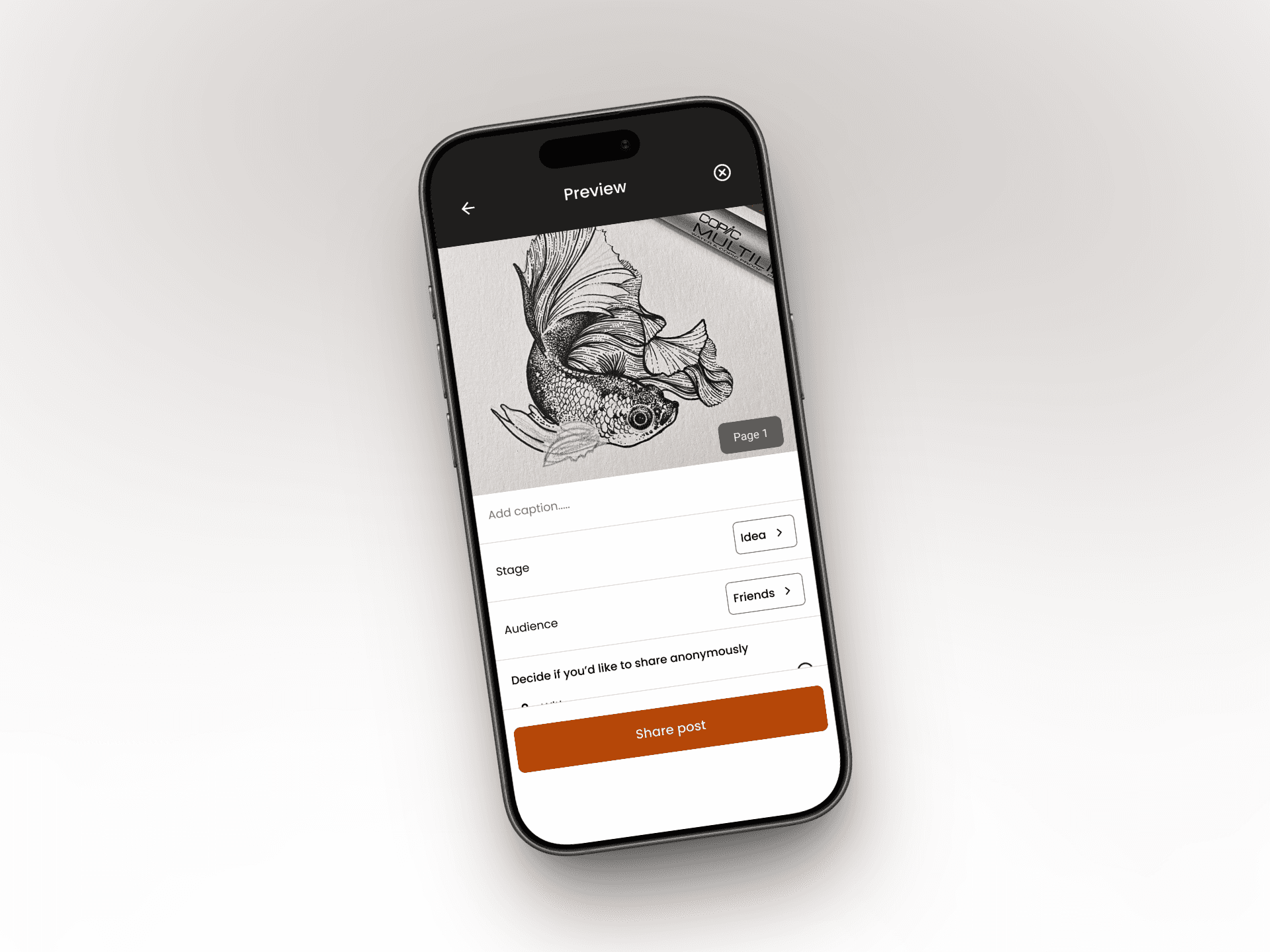
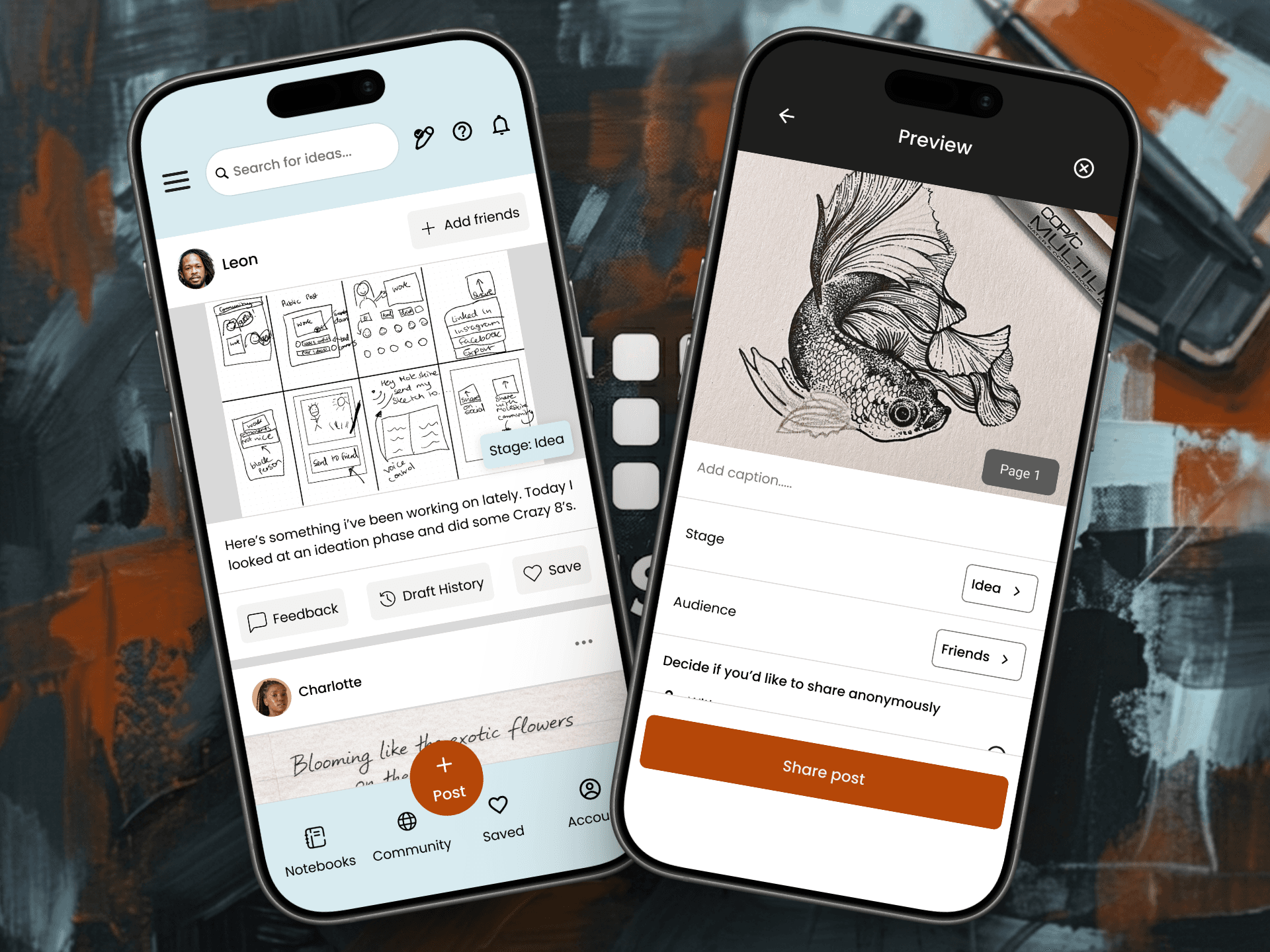
We designed a safe community built natively into the Moleskine Notes app. Creatives can tag their work stage (Idea, Draft, Completed), choose how it is shared (Friends or Public, anonymously or with their username) and receive feedback through structured prompts that encourage growth rather than judgement. We intentionally decided to create a platform without public metrics, leaderboards or gamification to reduce public pressures and build a creative, safe space which is what users wanted.
My Role
I was the PM and Prototype & Usability Testing Lead on a team of three, working alongside a Research & Synthesis Lead and a Ideation & IA Lead. I owned the lo-fi and hi-fi prototypes in Figma, planned and ran usability testing across both rounds, synthesised the SUS results, finalised our strategy, kept the project on track week-to-week, and translated testing insights into design changes across iterations. We all contributed to research and design decisions throughout.

01 Discover
Understand and uncover
Understanding creative’s motivations on social sharing.
To understand what motivates creatives to share online and what barriers they may face, we ran 6 moderated user interviews (recruited from our own networks) who were literary or visual creatives. Alongside our interviews we ran a competitive analysis to understand how other direct competitors like Remarkable and RocketBook implemented social sharing and what features were common in social network platforms like Instagram and LinkedIn. We synthesised our interviews with an affinity map to surface key insights and mapped out Moleskine's current ecosystem and products.

01
Psychological safety decides whether they share at all.
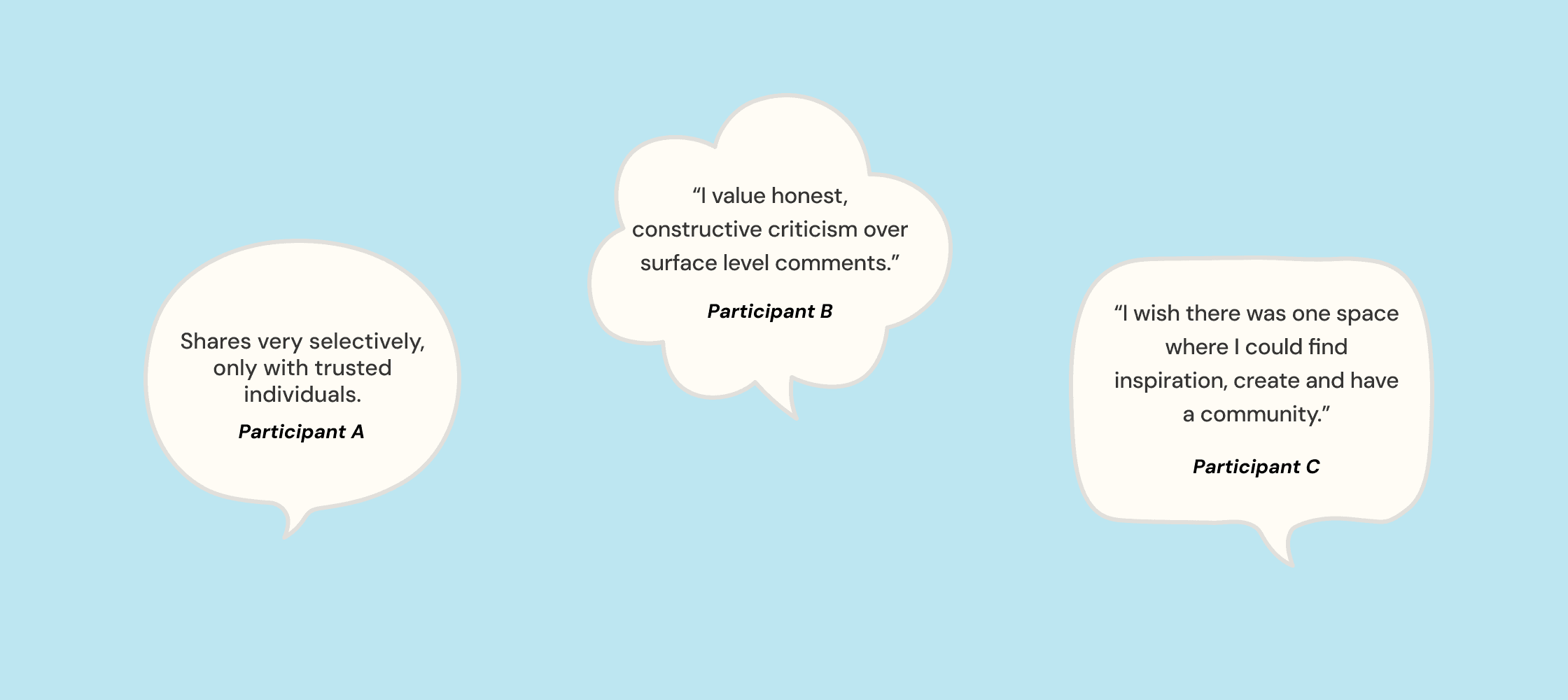
Across all 6 interviews, creatives shared their work very selectively and only with people they trusted. The biggest reason work stayed in the notebook was the fear that unfinished ideas would be judged as final. Without strong privacy controls, sharing wasn't worth the risk.
02
Constructive feedback is what they actually want.
Users didn't want likes or comments. They wanted honest, actionable critique and described surface-level engagement as worse than no feedback at all.
03
The market gap.
Direct competitors digitise notes but offer no community. Indirect competitors offer community but reward polish and performance. Nobody supports the full creative journey of capturing ideas and then sharing in a community that offers growth over comparison culture.
Carrying findings forward to define.
Creatives didn't need more visibility. They needed safety. We carried those three themes into defining a persona, a core problem and a focused set of How Might We questions.
01 Discover
Understand and uncover
Understanding creative’s motivations on social sharing.
To understand what motivates creatives to share online and what barriers they may face, we ran 6 moderated user interviews (recruited from our own networks) who were literary or visual creatives. Alongside our interviews we ran a competitive analysis to understand how other direct competitors like Remarkable and RocketBook implemented social sharing and what features were common in social network platforms like Instagram and LinkedIn. We synthesised our interviews with an affinity map to surface key insights and mapped out Moleskine's current ecosystem and products.
01
Psychological safety decides whether they share at all.
Across all 6 interviews, creatives shared their work very selectively and only with people they trusted. The biggest reason work stayed in the notebook was the fear that unfinished ideas would be judged as final. Without strong privacy controls, sharing wasn't worth the risk.
02
Constructive feedback is what they actually want.
Users didn't want likes or comments. They wanted honest, actionable critique and described surface-level engagement as worse than no feedback at all.
03
The market gap.
Direct competitors digitise notes but offer no community. Indirect competitors offer community but reward polish and performance. Nobody supports the full creative journey of capturing ideas and then sharing in a community that offers growth over comparison culture.
Carrying findings forward to define.
Creatives didn't need more visibility. They needed safety. We carried those three themes into defining a persona, a core problem and a focused set of How Might We questions.
02 Define
Focus and frame
Meet Samantha, our reflective creative.
We synthesised the research into one persona to keep decisions grounded in real user behaviours.

Samantha, 30, values feedback that helps her grow but hesitates to share unfinished work because she's afraid it'll be read as final. She wants strong privacy controls, a community that focuses on the process and receives thoughtful feedback on ideas in order to grow and develop her work.
Success meant a safe community first.
For Samantha, success meant feeling psychologically safe and confident enough to share work online without the fear of being misunderstood and feel motivated to continue sharing. For Moleskine, success meant a social network feature that helped their ecosystem thrive without diluting their brand by increased engagement with more people actively using the Smart notebook app and increased retention with owners repurchasing more Smart notebooks.
Exploring opportunities to help Samantha.
After creating a core problem statement we explored several HMW statements before landing on one to carry through to ideation.


02 Define
Focus and frame
Meet Samantha, our reflective creative.
We synthesised the research into one persona to keep decisions grounded in real user behaviours.
Samantha, 30, values feedback that helps her grow but hesitates to share unfinished work because she's afraid it'll be read as final. She wants strong privacy controls, a community that focuses on the process and receives thoughtful feedback on ideas in order to grow and develop her work.
Success meant a safe community first.
For Samantha, success meant feeling psychologically safe and confident enough to share work online without the fear of being misunderstood and feel motivated to continue sharing. For Moleskine, success meant a social network feature that helped their ecosystem thrive without diluting their brand by increased engagement with more people actively using the Smart notebook app and increased retention with owners repurchasing more Smart notebooks.
Exploring opportunities to help Samantha.
After creating a core problem statement we explored several HMW statements before landing on one to carry through to ideation.
03 Develop
Ideate and iterate
Crazy 8s to surface ideas fast.
The team sketched against the HMW in a round of Crazy 8’s and voted on the strongest ideas. Anonymous and private sharing, a creative community built inside the existing app, structured feedback prompts, voice accessibility and sharing to existing social platforms all surfaced as candidates.

Prioritising for MVP.
We mapped ideas on an impact vs effort matrix. Flexible privacy and audience controls and a dedicated creative community inside Moleskine were essential to the vision. Structured feedback prompts came in as a high-impact differentiator. We also made a deliberate call on not to build features like likes, follower counts, leaderboards, and options to share to external social platforms because interviews pointed to those features as the reason existing platforms felt unsafe.

Proposed user flow and ‘North Star’.
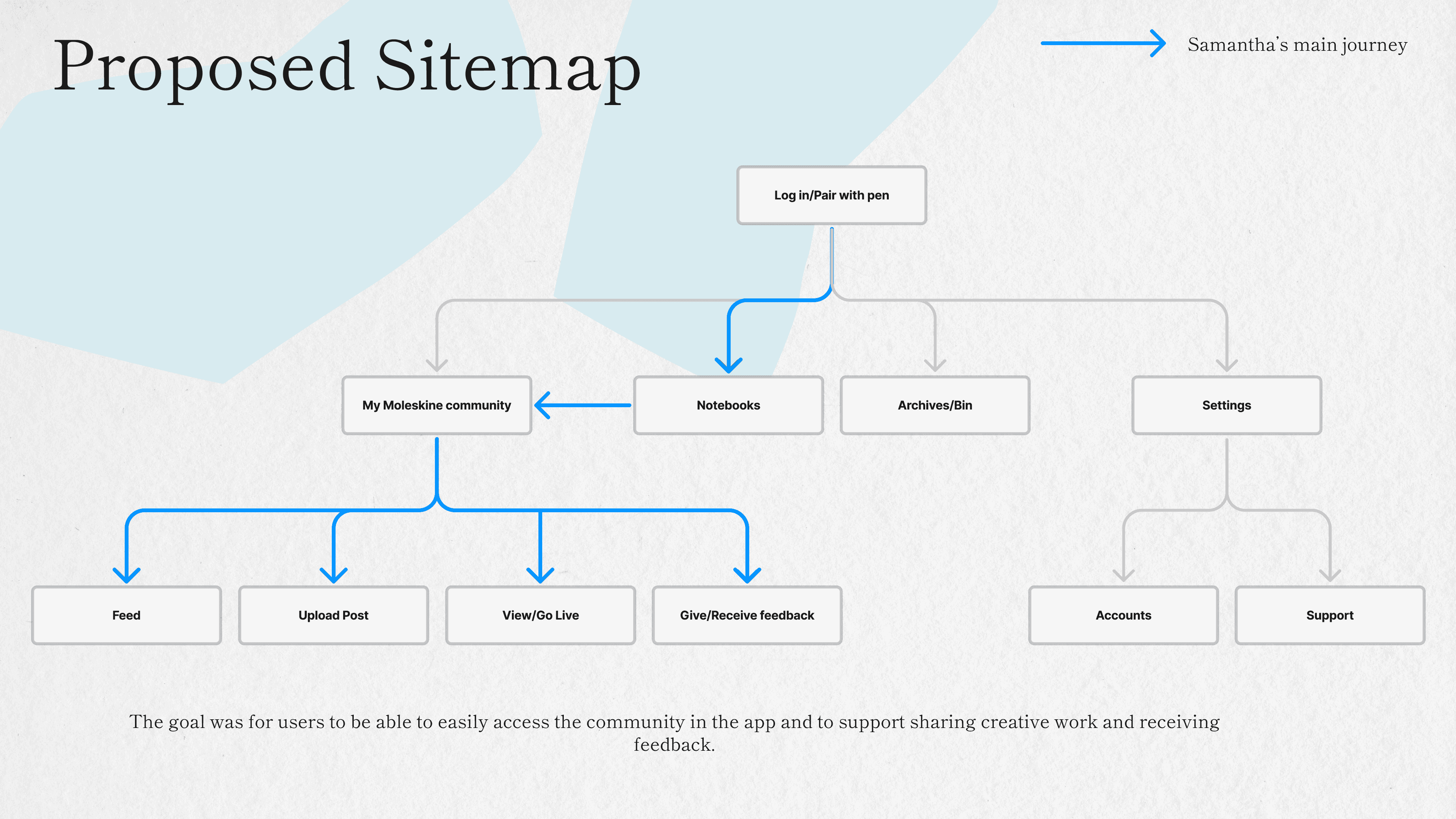
We mapped Samantha's journey with a goal for her to confidently share her work at any stage in the Moleskine community and to encourage creative development with thoughtful feedback, unlike traditional notebooks and existing platforms where feedback isn't possible or only polished outcomes are rewarded. Walking through her journey uncovered potential frictions and what to change in the flow.
From sketches to a lo-fi prototype.
Using the sitemap we each sketched our ideas on the main flow pages and I translated the wireframes into a clickable lo-fi prototype in Figma with four core features:
01
Stage tagging on every post
Idea, Draft and Completed labels so the audience knows the work isn't asking to be judged as final.
02
Audience and privacy controls
Friends or Public, with the option to post anonymously or with a username so that users can decide on who sees the post and how they show up on it.
03
Structured feedback prompts
A "What went well / What if / What could improve" framework that directly addresses the surface-level engagement creatives said they wanted to avoid.

Usability testing surfaced the real friction.
I planned and ran moderated usability testing with 6 participants across both lo-fi and mid-fi rounds. We wanted to see how users navigate the new social network feature from joining the community to finding it in the app, if they could share posts easily and feel confident with the given audience and privacy options and finally give thoughtful feedback on a post.
6/6 users appreciated the privacy and anonymity options.
All participants liked the option to select their audience and to share anonymously, validating the central insight from research. However, some users did want to learn more on how the community would be moderated before joining it.
The live forum feature blocked our main flow.
We included an option for live forums as a way to give feedback to others in real-time but quickly realised that this was out of our initial scope and users didn’t easily find their way to it when testing. We decided to remove this feature entirely as it wasn’t easily discoverable and it was an unnecessary, low impact feature which blocked the flow we actually cared about.
Buttons and certain language created hesitation.
Several users hesitated at the "Version" label, the accessibility icon and the search bar. The features worked but the labels and guardrails weren't clear enough so we reworded the ‘version’ label and rearranged some buttons to what users expected.
The takeaway.
We were adding too many features that weren't part of our MVP, we scaled back to our core flow and iterated on our Mid-fi prototype to what users actually wanted.
03 Develop
Ideate and iterate
Crazy 8s to surface ideas fast.
The team sketched against the HMW in a round of Crazy 8’s and voted on the strongest ideas. Anonymous and private sharing, a creative community built inside the existing app, structured feedback prompts, voice accessibility and sharing to existing social platforms all surfaced as candidates.
Prioritising for MVP.
We mapped ideas on an impact vs effort matrix. Flexible privacy and audience controls and a dedicated creative community inside Moleskine were essential to the vision. Structured feedback prompts came in as a high-impact differentiator. We also made a deliberate call on not to build features like likes, follower counts, leaderboards, and options to share to external social platforms because interviews pointed to those features as the reason existing platforms felt unsafe.
Proposed user flow and ‘North Star’.
We mapped Samantha's journey with a goal for her to confidently share her work at any stage in the Moleskine community and to encourage creative development with thoughtful feedback, unlike traditional notebooks and existing platforms where feedback isn't possible or only polished outcomes are rewarded. Walking through her journey uncovered potential frictions and what to change in the flow.
From sketches to a lo-fi prototype.
Using the sitemap we each sketched our ideas on the main flow pages and I translated the wireframes into a clickable lo-fi prototype in Figma with four core features:
01
Stage tagging on every post
Idea, Draft and Completed labels so the audience knows the work isn't asking to be judged as final.
02
Audience and privacy controls
Friends or Public, with the option to post anonymously or with a username so that users can decide on who sees the post and how they show up on it.
03
Structured feedback prompts
A "What went well / What if / What could improve" framework that directly addresses the surface-level engagement creatives said they wanted to avoid.
Usability testing surfaced the real friction.
I planned and ran moderated usability testing with 6 participants across both lo-fi and mid-fi rounds. We wanted to see how users navigate the new social network feature from joining the community to finding it in the app, if they could share posts easily and feel confident with the given audience and privacy options and finally give thoughtful feedback on a post.
6/6 users appreciated the privacy and anonymity options.
All participants liked the option to select their audience and to share anonymously, validating the central insight from research. However, some users did want to learn more on how the community would be moderated before joining it.
The live forum feature blocked our main flow.
We included an option for live forums as a way to give feedback to others in real-time but quickly realised that this was out of our initial scope and users didn’t easily find their way to it when testing. We decided to remove this feature entirely as it wasn’t easily discoverable and it was an unnecessary, low impact feature which blocked the flow we actually cared about.
Buttons and certain language created hesitation.
Several users hesitated at the "Version" label, the accessibility icon and the search bar. The features worked but the labels and guardrails weren't clear enough so we reworded the ‘version’ label and rearranged some buttons to what users expected.
The takeaway.
We were adding too many features that weren't part of our MVP, we scaled back to our core flow and iterated on our Mid-fi prototype to what users actually wanted.
04 Deliver
Ship and measure
From mid-fi to hi-fi with brand and accessibility in mind.
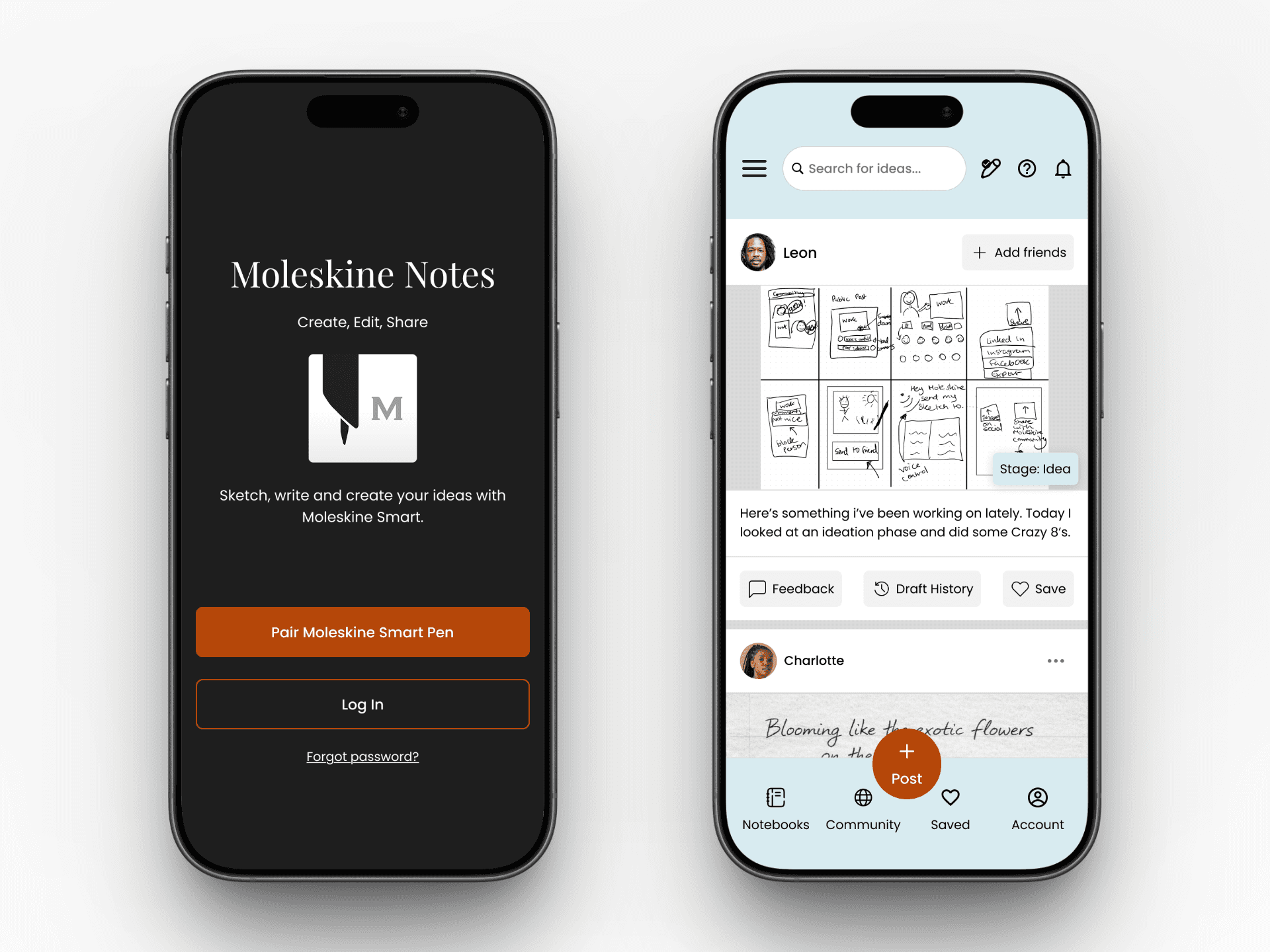
I built the hi-fi prototype in Figma using Moleskine's brand palette but adapted the colours slightly to ensure accessibility met WCAG standards. The look stayed quiet and editorial, honouring the existing brand.

A community that protects the process, not the outcome.
The final solution is a community feature built natively into the Moleskine Notes app. Users onboard by pairing their Smart Pen and reading clear community guidelines. They browse a feed, upload work straight from their notebooks, tag the stage and choose how the post is shared. They give feedback through a prompted framework or in free text. No likes, no follower counts, no leaderboards, just creatives supporting each other's process.
SUS increased between rounds.
SUS lifted from 66 to 72, a 6 point improvement, past the 68 benchmark. 100% of participants found the app clear after iteration and 75% described it as accessible and useful. A few still flagged the feedback prompts as slightly restrictive in places, which became a clear next step for further testing.
How we answered the brief.
Moleskine asked for a social feature that would grow engagement and Smart Notebook repurchases without losing what made the brand feel like Moleskine. The redesign answered that on three fronts. Engagement through a feed that rewards process and a feedback framework that makes responses worth reading. Retention through audience controls and stages that make the app a place people come back to, not perform on. Repurchases through a community feature that only works inside the Smart Notebook ecosystem, so the notebook itself becomes the entry point.

04 Deliver
Ship and measure
From mid-fi to hi-fi with brand and accessibility in mind.
I built the hi-fi prototype in Figma using Moleskine's brand palette but adapted the colours slightly to ensure accessibility met WCAG standards. The look stayed quiet and editorial, honouring the existing brand.
A community that protects the process, not the outcome.
The final solution is a community feature built natively into the Moleskine Notes app. Users onboard by pairing their Smart Pen and reading clear community guidelines. They browse a feed, upload work straight from their notebooks, tag the stage and choose how the post is shared. They give feedback through a prompted framework or in free text. No likes, no follower counts, no leaderboards, just creatives supporting each other's process.
SUS increased between rounds.
SUS lifted from 66 to 72, a 6 point improvement, past the 68 benchmark. 100% of participants found the app clear after iteration and 75% described it as accessible and useful. A few still flagged the feedback prompts as slightly restrictive in places, which became a clear next step for further testing.
How we answered the brief.
Moleskine asked for a social feature that would grow engagement and Smart Notebook repurchases without losing what made the brand feel like Moleskine. The redesign answered that on three fronts. Engagement through a feed that rewards process and a feedback framework that makes responses worth reading. Retention through audience controls and stages that make the app a place people come back to, not perform on. Repurchases through a community feature that only works inside the Smart Notebook ecosystem, so the notebook itself becomes the entry point.
Next steps
01
More usability testing on the hi-fi
Six participants across two rounds validated the direction, but I'd want to test the hi-fi with a wider pool, particularly around accessibility needs to validate the brand refresh, the feedback prompts and the new onboarding before recommending shipping.
02
Iterating on the feedback framework
The prompts were one of the most loved features in concept but the most constrained in practice. I'd want to test variations on the framework by fewer, optional and tailored prompts to the stage, in order to find the right balance between structure and freedom.
03
Personalised feed onboarding
Capturing creative interests and feedback preferences early so the community feed is relevant from day one and Samantha sees the right work and people first.
Next steps
01
More usability testing on the hi-fi
Six participants across two rounds validated the direction, but I'd want to test the hi-fi with a wider pool, particularly around accessibility needs to validate the brand refresh, the feedback prompts and the new onboarding before recommending shipping.
02
Iterating on the feedback framework
The prompts were one of the most loved features in concept but the most constrained in practice. I'd want to test variations on the framework by fewer, optional and tailored prompts to the stage, in order to find the right balance between structure and freedom.
03
Personalised feed onboarding
Capturing creative interests and feedback preferences early so the community feed is relevant from day one and Samantha sees the right work and people first.
Key Learnings
Psychological safety is the product.
The reason existing platforms fail creative communities isn't a design flaw, it's a value flaw. Building safety meant actively removing features that drive comparison and including features that helped increase creative exploration and development which is what users wanted.
Scaling back to the MVP.
We prioritised features early, but sketching surfaced ideas that crept outside the MVP. The live forum was the obvious one, we got attached to it in ideation, but testing showed it was blocking the main feedback flow. Removing it was the cleanest iteration and one to revisit later.
Why this project stuck with me.
This was my first group project and the first time I led on prototyping and testing. Owning the prototype and testing allowed me to see where users were facing friction and then translating their hesitation into iterations was the part I really loved. It also showed me that the hardest design decisions aren't about what to add, they're also about what to leave out so the product can mean what you want it to mean.
Key Learnings
Psychological safety is the product.
The reason existing platforms fail creative communities isn't a design flaw, it's a value flaw. Building safety meant actively removing features that drive comparison and including features that helped increase creative exploration and development which is what users wanted.
Scaling back to the MVP.
We prioritised features early, but sketching surfaced ideas that crept outside the MVP. The live forum was the obvious one, we got attached to it in ideation, but testing showed it was blocking the main feedback flow. Removing it was the cleanest iteration and one to revisit later.
Why this project stuck with me.
This was my first group project and the first time I led on prototyping and testing. Owning the prototype and testing allowed me to see where users were facing friction and then translating their hesitation into iterations was the part I really loved. It also showed me that the hardest design decisions aren't about what to add, they're also about what to leave out so the product can mean what you want it to mean.